Guided
A supervisor at the student’s side
Dr. Amara coaches the method, not the answer: ten fixed coaching moments, help when a student stalls, and a panel to ask a question. Tests stay locked until a first impression is on the record.

The platform
From the first question at the bedside to the report the next morning: everything a student does with a patient, in one place, on a clock.
A shift, not a quiz
Vitals change, the patient answers when spoken to, and time moves only when the student acts. This is Georgi Kavtaradze’s case, as its author wrote it.
The times above are the ones the case was written to reward. In a student’s run, the clock follows their decisions, and so does the night.
Two ways to work
The same patient and the same scoring, in two modes.
Guided
Dr. Amara coaches the method, not the answer: ten fixed coaching moments, help when a student stalls, and a panel to ask a question. Tests stay locked until a first impression is on the record.
Independent
No supervisor and no hints. The patient, the clock and the debrief stay the same, so results compare across a cohort.
The debrief
After the night, the student sees what was done, when, and what it led to. During the case, the literature for this patient is one tap away, with PubMed links.
The student also presents the patient, and an AI preceptor grades that presentation against the case author’s own.
Mini-CEX-style practice scores. Not a formal assessment.
After Scott IA, Errors in clinical reasoning: causes and remedial strategies. BMJ 2009;338:b1860.
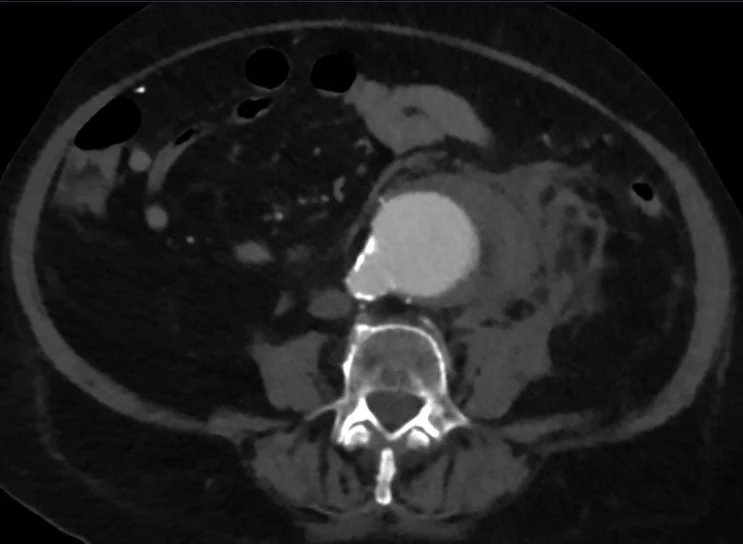
One representative axial slice from the CT angiogram of the abdominal aorta.
Image: Hellerhoff, Wikimedia Commons, CC BY-SA 4.0, cropped to one axial panel.
Imaging
Results come back as they would on the ward, with the image itself. In Georgi’s case the CT does not make the diagnosis; it plans the operation, and sending him to the scanner before the surgeon and the blood is a decision the debrief will name.
Schools add their own CT series, images and surgical video, and check their own material.
Around the encounter
The ward
Students see every patient their school has opened to them, and pick the next one or let the shift choose.
Bedside
Students walk up to the patient and examine him: they point at a region, choose a technique, and only then see what they found.
Review
Knowledge checks bring back what a student missed, spaced over the following days, until it sticks.
Logbook
Each encounter stays in the student’s logbook with its debrief and scores, to come back to before the next shift.
The case library
Every case passes automated checks and a physician’s review against a 15-point protocol before any student sees it.
01
From a teaching source: the patient, the findings, the results, and the ways the night can go.
02
A critic flags leaks, gaps and contradictions before a person reads it.
03
A physician who did not write the case reads it, plays it, and confirms fifteen statements.
04
Only then is it published. Your faculty can write cases the same way.
The diagnosis and its presentation are real medicine: this patient can exist exactly as described.
Findings and their margins are consistent with the condition and stage; no finding contradicts the diagnosis.
Nothing dangerous is taught: no wrong doses, no harmful sequence presented as correct, no missing contraindication that matters at this level.
The exemplar summary is what a competent clinician would actually say; it is accurate and complete for this presentation.
Four of the fifteen statements a reviewer confirms, word for word.
Pricing
One site license
Every student and every faculty member: no per-student fees and no account caps.
AI usage
Included AI usage follows your number of active students, with transparent top-ups if you outgrow it.
Releases
New releases every few weeks, with no upgrades to buy.
A number in writing
One 30-minute call, then a written proposal. No contact-sales black box.
