Catch-up 3 of 4
Evidence and team: how we know it works, and who builds it.
Schools buy on trust: that the medicine is right, that students learn and that the team will be there. This chapter shows how we learn from what students do, how a physician checks every patient we publish, the randomised study we designed with a faculty in Brazil, and who builds ALYT.
In this chapter
- 01We learn from what students do
- 02A physician checks every patient we publish
- 03A randomised study with a faculty in Brazil
- 04The team
We learn from what students do
Evidence is also what students actually do. Every action in ALYT is recorded with its time, so we see where a student gets stuck and can fix it within days.
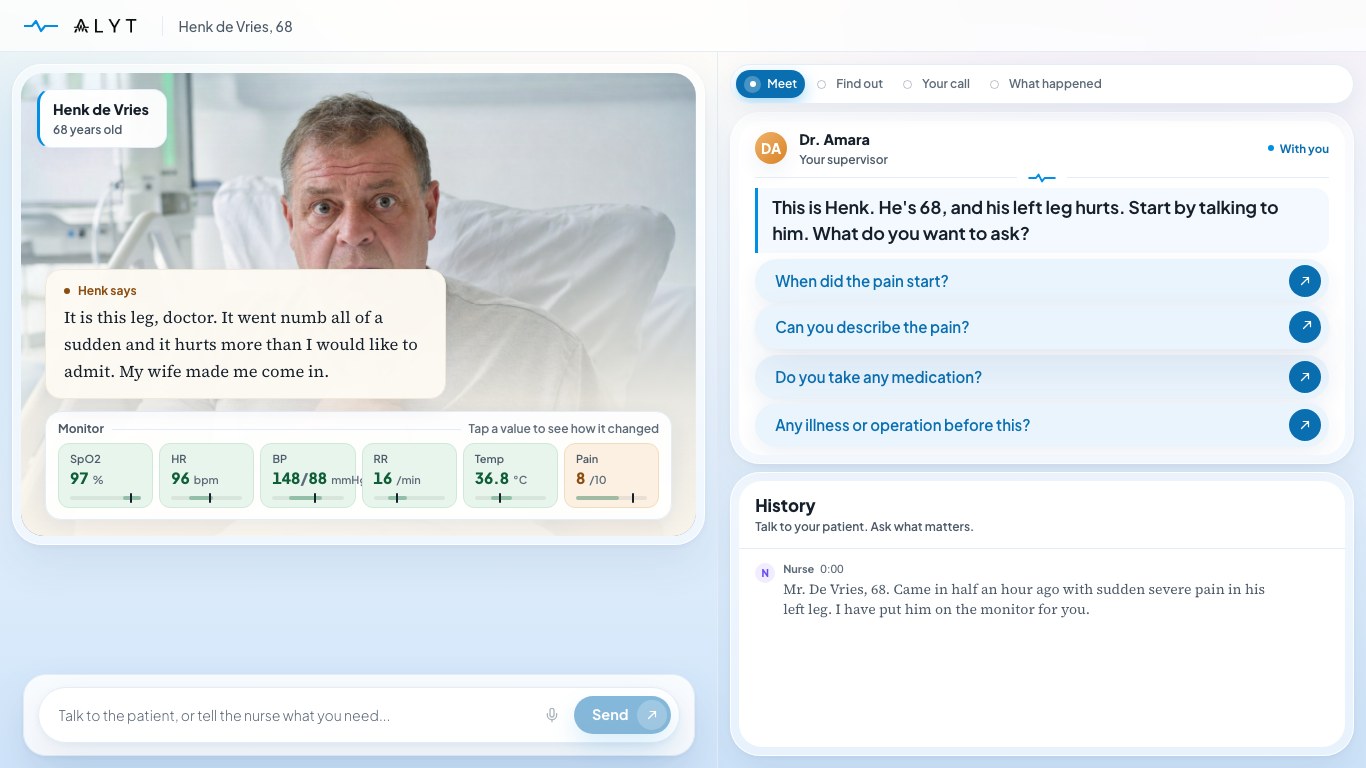
Each question, test and treatment is stored with its time, so we see where students hesitate.
In the first pilot weeks, many new students stopped before their first impression.
While a test result is on its way, the student sees what to do next.
A supervisor at the student's side for the first patient. Switched on per school.
An AI that plays every patient through the real screen and reports where it gets stuck.
A physician checks every patient we publish
Medicine has to be right. Every patient starts from a written teaching source and goes live only after a physician approves it.
Guidelines and references behind each case, such as the 2023 Turkish guideline for brucellosis.
Checks each case against its source and flags what needs a physician's decision.
Our Medical Director approves a patient before it is published.
A school's own teachers review the patients built for their students.
A randomised study with a faculty in Brazil
The strongest evidence is a fair comparison. Together with a faculty of medicine in Brazil we designed a randomised study in paediatrics.
28 students: half practise with ALYT, half follow the usual teaching.
The outcome is the Mini-CEX, a standard bedside assessment, scored by a faculty member who does not know the groups.
Paediatric patients built around the module's own topics.
A data processing agreement between the university and ALYT.
The team
A small team that combines a clinical teacher with 27 years of training surgeons, and a builder who ships every week.
Leads the company, the product and sales.
Vascular surgeon and founder of the European Vascular Course, which he led for 27 years.
Teachers who review the patients built for their own students.
We build and test with AI agents, which is how 196 changes shipped in 20 weeks.
What comes next
Next week, catch-up 4 of 4: our plan for 2027.